The Giving Ground
An Outdoor Mindfulness Initiative for Youth Volunteers
Because those who care for others must also care for themselves.
Why This Matters
Volunteering brings fulfillment, social connection, and personal growth — but can also lead to burnout, stress, fatigue, and reduced engagement.
The Insight
"Prosocial behaviour is often limited not by a lack of compassion, but by attentional blind spots."
— Hafenbrack et al., 2020
Our Response: The Giving Ground
We equip youth volunteers with simple, practical mindfulness techniques to cope with stress and sustain their ability to contribute meaningfully. By learning to recognize and manage emotional triggers, volunteers can stay grounded—both in their own wellbeing and in their commitment to helping others.
Why Volunteers Need Mindfulness
Volunteering is deeply rewarding, but it is not without its costs. Youth volunteers face unique pressures that, left unaddressed, can quietly erode their wellbeing.
Emotional Labour
Volunteers regularly engage with people facing hardship. Absorbing others' distress without proper tools to process it leads to accumulated fatigue.
Unclear Boundaries
Because volunteering is driven by goodwill, it can be hard to say no or step back. This blurs the line between caring and emotional burnout.
Unpaid, Undervalued
Without formal structures like compensation or professional support, volunteers often lack resources to ask for help when struggling.
Cumulative Stress
Youth volunteers balance school, work, and service. Stress accumulates silently until it becomes overwhelming and they disengage.
Mindfulness gives volunteers a way to stay present and caring without losing themselves.
Research shows that brief mindfulness practices reduce perceived stress, improve emotional regulation, and restore a sense of purpose—all critical for long-term volunteer engagement.
Being Grounded to Give
A 1–1.5 hour experiential session designed to equip youth volunteers with practical mindfulness tools.
Duration
~1–1.5 hours
Format
Experiential outdoor learning
Participants
Youth volunteers (students & young adults)
Location
YPHSL Rooftop, SMU
Three Learning Goals
Manage Stress
Develop strategies to manage stress and emotional fatigue
Awareness
Build awareness of emotions, thoughts, and bodily responses
Sustain Practice
Sustain mindfulness practices in volunteering and daily life
Four Practices for Presence
Each technique is simple enough to use immediately and deep enough to explore for a lifetime. Click any practice to reveal the complete guide.
The CEO of BETA technique puts you in charge of your inner experience. As a volunteer, you often focus outward on helping others. This practice brings attention inward, helping you understand your current state so you can serve from a place of awareness rather than depletion.
B — Body
Close your eyes if comfortable. Scan your body from head to toe. Notice areas of tension or ease. Where are you holding stress? Perhaps tight shoulders from lifting supplies, or fatigue in your legs from standing. Simply notice without judgment. Your body carries the story of your service.
E — Emotions
What emotions are present right now? Compassion fatigue? Joy from a meaningful connection? Frustration from challenges? Name them gently. As volunteers, we absorb the emotions around us—the gratitude of those we help and sometimes their pain. Acknowledging your emotional state is an act of self-care.
T — Thoughts
Observe your thoughts like clouds passing through the sky. What mental stories are you telling yourself? "I should be doing more." "I'm not making a difference." "This is so rewarding." Notice the quality of your thinking without trying to change it. Thoughts come and go; you are the observer.
A — Awareness
Now, expand your awareness to hold all of this—body, emotions, thoughts—in a spacious container of presence. You are the CEO of your inner world. From this place of awareness, you can make conscious choices about how to respond to whatever arises in your volunteer work.
Volunteer Tip
Practice CEO of BETA during your commute to volunteer sites, during breaks, or at the end of a shift. It takes only 2-3 minutes and helps prevent the accumulation of unprocessed stress.
Volunteering can bring unexpected challenges—difficult situations, emotional encounters, or moments of overwhelm. The STOP Technique is your emergency pause button, a way to interrupt automatic stress reactions and respond with intention.
S — Stop
When you notice stress building—your heart racing, thoughts spiraling, or frustration rising—simply stop what you're doing. This deliberate pause interrupts the automatic pilot mode. If you're in the middle of a task, it's okay to pause. Even a micro-pause of one second counts.
T — Take a Breath
Take one conscious breath. Feel your feet on the ground. Let the exhale be slightly longer than the inhale. This single breath activates your parasympathetic nervous system, telling your body it's safe to come out of fight-or-flight mode. You don't need five minutes—one real breath is enough.
O — Observe
Notice what's happening in this moment. What triggered you? What sensations are in your body? What story is your mind telling? Also observe the external situation with fresh eyes. Often, when we pause and observe, we see options we missed when we were reactive.
P — Proceed
Now choose how to move forward. With your nervous system calmed and your perspective widened, you can respond rather than react. Maybe you proceed with the same action but with less urgency. Maybe you ask for help. Maybe you recognize you need a proper break.
Volunteer Tip
Use STOP when a person you're helping becomes upset, when you receive difficult news, or when you feel your patience wearing thin. It's invisible to others and takes only seconds, but it can transform your experience.
Gratitude is protective. Research shows that regular gratitude practice increases resilience, improves sleep, and strengthens immune function—all vital for sustainable volunteering. This isn't about toxic positivity or ignoring difficulties; it's about training your brain to also notice what's good.
Choose Your Moment
Pick a consistent time for this practice—perhaps at the end of your volunteer shift, during your evening routine, or before sleep. Consistency matters more than duration. Even one minute of genuine gratitude rewires your neural pathways over time.
Recall Three Specifics
Think of three things from your day that you're grateful for. Be specific. Instead of "I'm grateful for the people I help," try "I'm grateful for the smile from Maria when I handed her the meal." Specificity makes gratitude feel real and engages your memory more deeply.
Feel the Feeling
Don't just think the gratitude—feel it in your body. Where does appreciation live in you? Perhaps warmth in your chest, or a softening in your shoulders. Staying with the feeling for 15-30 seconds allows it to become a lasting neural memory rather than a passing thought.
Notice the Small Things
Volunteers often witness both profound suffering and profound beauty. Include small moments: a good cup of coffee, a fellow volunteer's joke, the sunset on your drive home. These small gratitudes are the building blocks of a resilient spirit.
Volunteer Tip
Start a gratitude exchange with fellow volunteers. At the end of each shift, share one grateful moment. This builds community and multiplies the benefits of the practice.
You already walk throughout your volunteer work—to and from locations, between tasks, during outreach. Mindful walking transforms these ordinary moments into opportunities for presence. It's meditation for people who don't have time to sit still.
Start Where You Are
You can practice mindful walking anywhere: on the way to your volunteer site, walking between rooms, or during a dedicated walking break. You don't need a special location or even privacy. The practice is internal and invisible to others.
Feel Your Feet
As you walk, bring attention to your feet. Notice the heel touching down, the roll through the arch, the push-off from the toes. Feel the ground supporting you with each step. This simple attention anchor pulls you out of mental chatter and into the present moment.
Sync with Breath
Gently coordinate your steps with your breath. Perhaps inhale for three steps, exhale for three steps. There's no right ratio—find what feels natural. This synchronization creates a rhythm that calms the nervous system and focuses the mind.
Expand Your Awareness
While keeping your feet as the anchor, allow your awareness to include other sensations: the air on your skin, sounds around you, colors in your peripheral vision. Walk as if you're walking for the first time, with curiosity and openness.
Volunteer Tip
Try walking mindfully from your car to the volunteer site. These few minutes can serve as a transition, helping you arrive fully present for those you serve. The walk home can be a decompression practice.
Take It With You
We created a pocket-sized guide so you can revisit your mindfulness practices anytime, anywhere. Free to read, free to share.
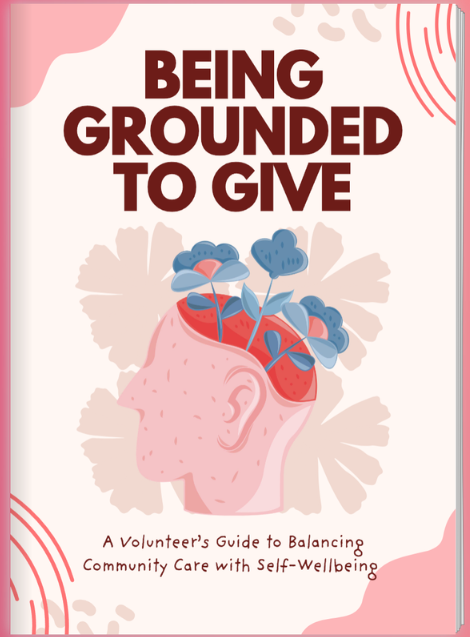
Being Grounded to Give
Browse our interactive digital flipbook — an 8-page volunteer's guide to balancing community care with self-wellbeing. Flip through it just like a real book.
Read the Flipbook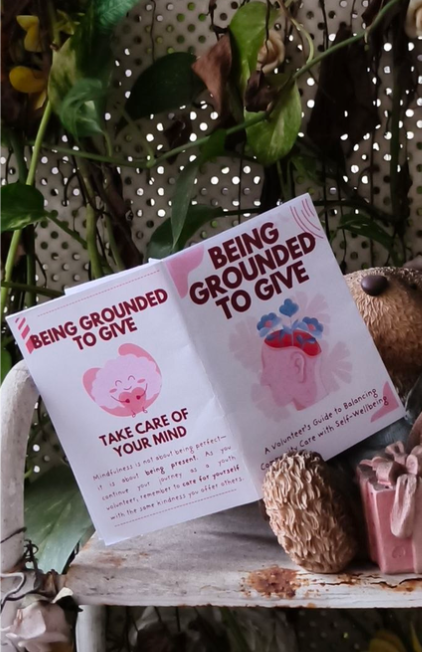
The 8-Page Minibook
Download the print-ready PDF and fold it into a pocket-sized zine you can carry with you. Perfect for sharing with fellow volunteers or keeping on your desk.
Download the Minibook“Mindfulness is not about being perfect — it is about being present.”
From Our Sessions
Capturing the quiet moments of presence and connection on the rooftop.
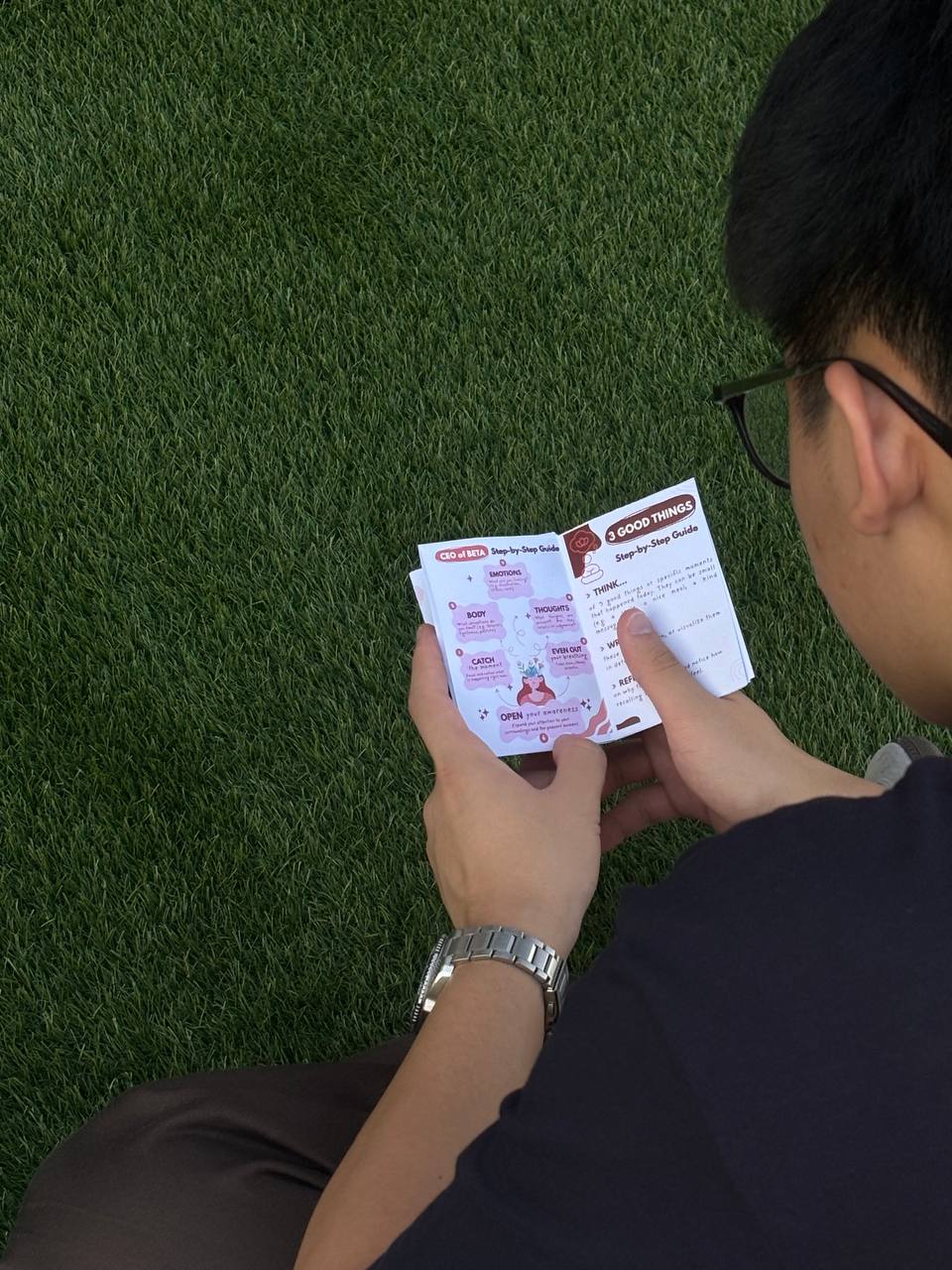
Practicing with the CEO of BETA guide during the rooftop session

The full group practicing mindful walking overlooking the city
What We Found
Pre-post evaluation data from pilot sessions shows meaningful improvements across all dimensions.
Overall Improvement: Composite scores improved from 3.33 → 4.28 (on a 5-point scale). All participants improved. Strongest gains: Self-awareness (+1.33, p = 0.009) and Focus/Presence (+1.08, p = 0.041).
Key Outcomes
Increased Awareness
Participants developed greater awareness of internal states—thoughts, emotions, and bodily sensations. This heightened self-awareness is the foundation for intentional action.
Reduced Reactivity
Participants felt calmer and less reactive to stress. The STOP Technique and CEO of BETA were highlighted as the most useful tools for managing difficult moments.
Shifted Perspective
A key insight emerged: self-care is not separate from helping others, but essential to sustaining meaningful service. This reframing shifted how participants understand their wellbeing.
Grounded in Research
Hafenbrack et al. (2020)
Mindfulness increases prosocial behaviour by improving attentional awareness and reducing cognitive overload.
MBSAT Research
Mindfulness-based Strategic Awareness Training creates a pause between stimulus and response, enabling intentional action.
Looking Up (Kiken & Shook, 2011)
Mindfulness reduces negativity bias and supports emotional regulation, key factors in sustaining volunteering.